
Growth gets stuck between strategy and execution.
The missing commercial capability gets built into the business, and stays.
From insight to productization, operating model and scaling, connected as one end-to-end commercialization model that stays in your organization.
Synchronization of Commercialization and Operational Actions™
The core principle: commercial and operational work designed and executed together not in sequence, not in silos.
THE GAP
What "the capability isn't there yet" actually looks like
The strategy is usually sound. What’s missing is the capability to commercialize it end-to-end, in four concrete ways.

No real customer insight
Growth decisions rest on assumptions and guess, not on what the market and customers actually do.

Each function hits its own KPIs. No one owns the customer journey.

Channels run in parallel
On many channels, connected across none. The customer feels every gap.

Tools in use but cut off from how the business sells. They never reach impact.
SYNCHRONIZATION OF COMMERCIAL & OPERATIONAL ACTIONS™
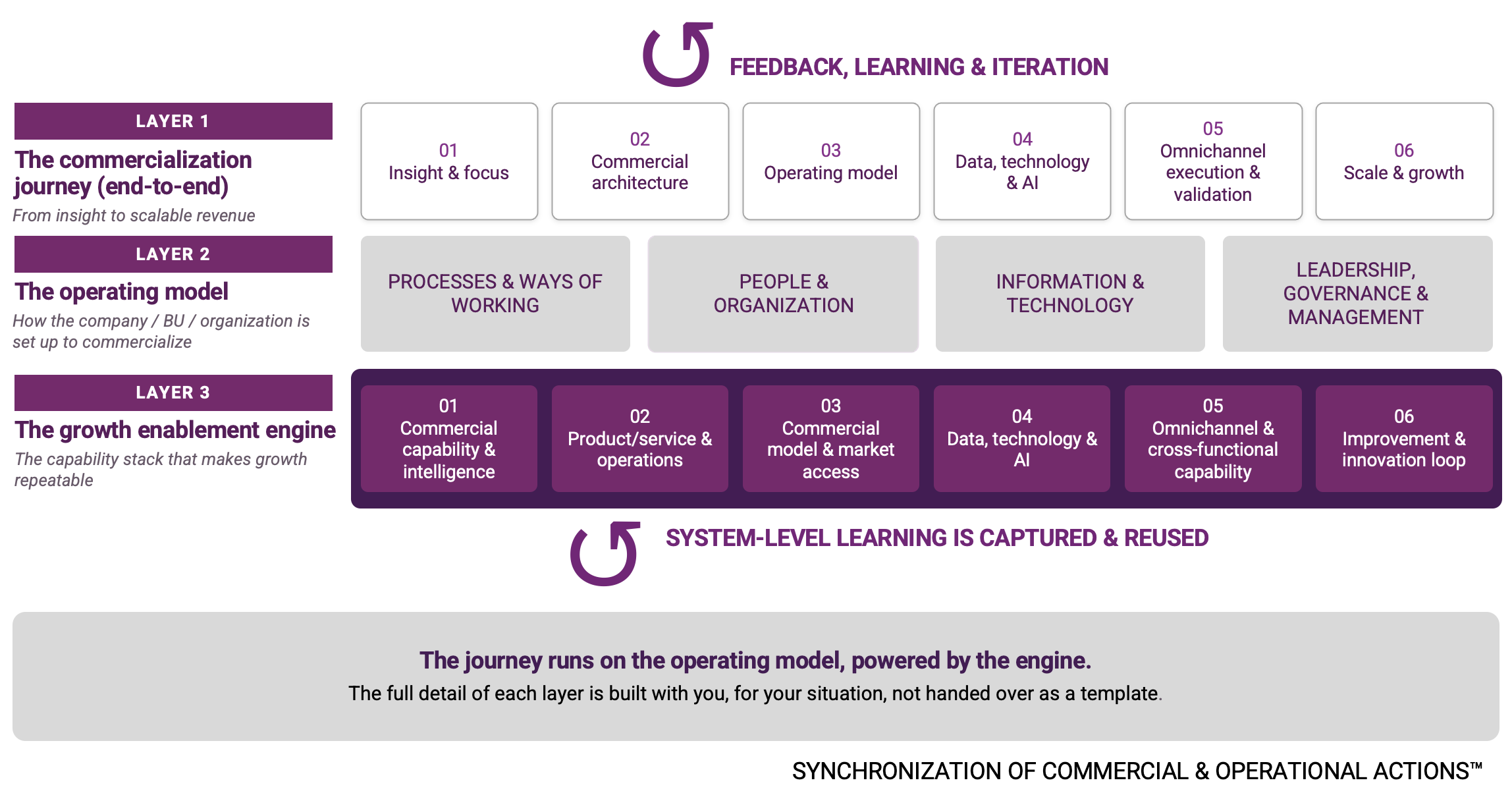
One end-to-end commercialization model built in three connected layers
This is how the missing capability gets built. A commercialization operating model determines how your commercial and operational capabilities work together to create and capture customer value.
The core principle: commercial and operational work designed and executed together not in sequence, not in silos.
THE DIFFERENCE IT MAKES
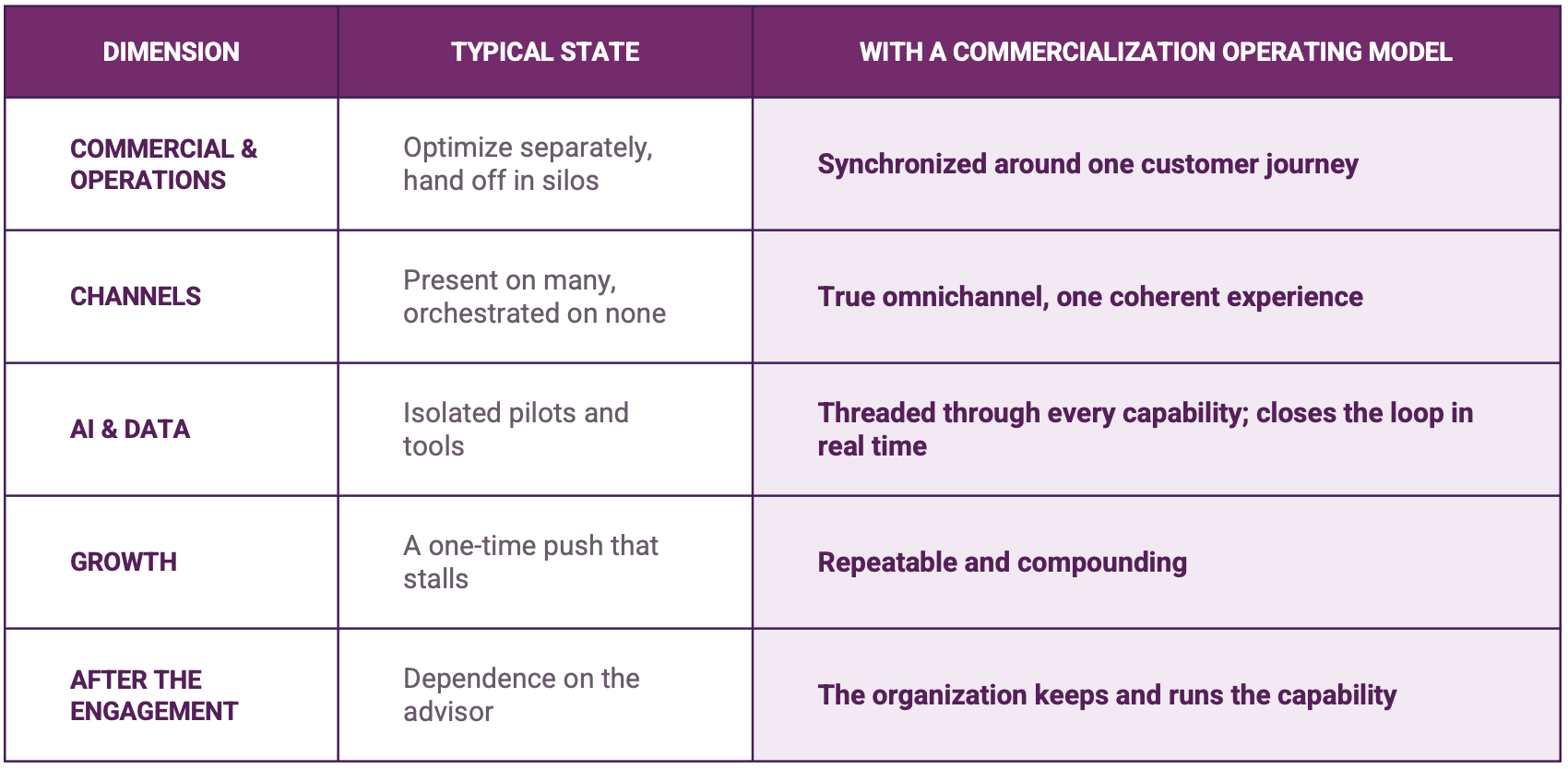
What changes when growth becomes a capability
The shift is from one-time growth to a capability your organization keeps and runs.
PRINCIPLES
What runs through every engagement
This is how the missing capability gets built. A commercialization operating model determines how your commercial and operational capabilities work together to create and capture customer value.
The core principle: commercial and operational work designed and executed together not in sequence, not in silos.

Insigths & iterative

Systematic value creation & capture

Hands-on & resilience

Fact-based & relevant

Cross-functional & systemic
COMMON QUESTIONS
Questions buyers ask
Q1 What is a commercialization operating model?
Q2 How is omnichannel a capability rather than a channel strategy?
Q3 Where does AI fit in a commercialization operating model?
Q4 What's the difference between an operating model and a playbook?
Q5 Who is this for?
B2B companies, typically €10M–€100M in revenue, across Finland, the EU and the US, that have something worth scaling but whose growth has stalled or depends on one-off pushes. Clients are usually CEOs, owners or commercial leaders who have a strong product but lack the end-to-end capability to commercialize it repeatably. The method is industry-agnostic and has been applied across manufacturing, technology, biotech, healthcare, retail and professional services.
Let's discuss what should be fixed first.
Call, WhatsApp or email — whichever works best.